You have people in the world who post quotes like the following one on their social media profile in hopes of having you think they are that they all about that renegade lifestyle…
The reasonable man adapts himself to the world; the unreasonable one persists in trying to adapt the world to himself. Therefore, all progress depends on the unreasonable man.
~George Bernard Shaw
But if this same person talking a big game on Instagram unknowingly wore a body cam that rolled for all their waking hours, the reality-based footage of their actual life would reveal they are among the smooth talkers of this quote…
Smooth talkers aren’t usually smooth doers and smooth doers are not usually smooth talkers.
My favorite people to model are Smooth Doers.
People who GENUINELY embody that George Bernard Shaw quote with every fiber of their being and have incredible results to show for it.
People whose entrepreneurial track record demonstrates that they don’t just talk about it; they BE about it.
Today I want to introduce you to an entrepreneur who within an hour of listening to him being interviewed for three-hours by Tim Ferriss, I knew that you would love this man’s story if you are a fan of Dan Kennedy’s Renegade Millionaire high concept…
MBA vs. TBFIS
There’s a very good reason why a lot of MBA’s are useless in real business.
They have no sales experience.
I prefer a TBFIS: Trial-By-Fire-In-Selling.
If you looked for THE commonality in all the 100+ Renegade Millionaires I’ve worked with, it would be that they know how to sell, have no compunctions about selling, and in 90% of the cases, have, in fact, sold “on the street”, nose to nose, toes to toes.
You would also find this commonality in the majority of the 100 wealthiest Americans list published each year by Forbes – in fact, if you exempted those on the list with inherited wealth, and analyzed only those who’ve gotten there on their own, you’d find this commonality in better than half, and no other comparable commonality.
Several years ago, I checked this against the Inc. Magazine list of 100 fastest growing companies; over 70% of their founders had this commonality.
This ‘secret’ is so profound, were I hiring a key person, it would be a litmus test.
And I would rank this kind of hard-nosed direct selling experience far more useful to the entrepreneur than an MBA.
Your son or daughter will learn and grow more in 6 months selling water purifiers, pool filters, vacuum cleaners or fire alarms to homeowners or imprinted ad specialties, copy machines or coffee service to businesses than from their entire college education.
One of the many things you learn from such selling is that it is based on a system. Some methodical system(s) for acquiring leads and getting appointments. A very methodical system for actually making the sales presentation and closing the sale.
It is critical to get comfortable with and competent at selling, and to surround yourself with people who share that comfort and competence.
Even though I trust Tim, there are times where I see the name of the person he’s interviewing, don’t recognize it and need to read the text in his intro to see if this is an episode I want to go on a 3 hour journey with.
I don’t know why I read the following title and intro text and STILL decided to download and start listening to the Nick Kokonas episode titled…
How To Apply World-Class Creativity to Business, Art, and Life
Nick Kokonas (IG: @nkokonas, TW: @NickKokonas) is the co-owner and co-founder of The Alinea Group of restaurants, which includes Alinea, Next, The Aviary, Roister, and The Aviary NYC.
He is also the founder and CEO of Tock, Inc, a reservations and CRM system for restaurants with more than 2.5M diners and clients in more than 20 countries.
Alinea has been named the Best Restaurant in America and Best Restaurant in The World by organizations and lists as diverse as The James Beard Foundation, World’s 50 Best, TripAdvisor, Yelp, Gourmet Magazine, and Elite Traveler.
His restaurants have won nearly every accolade afforded to them.
I don’t do anything in the “art” space.
I have zero interest in going into the restaurant business.
I’m not an aspiring chef.
I’m not a “foodie” who makes it a point to tick the “World’s 50 Best Restaurants” off of my bucket list.
I’m usually super leery of generalized promises like “how to be more creative” – ESPECIALLY when said promises are supposed to magically apply to everything under the sun as Tim has done by tacking on “and Life” to the title of this podcast.
And yet, after spending six-hours listening to the podcast twice and taking the valuable notes on it that I’m going to share with you here, I’ve come to the conclusion that a MUCH more fitting title for the treasure that is buried in this interview would be…
How To Succeed In Business By Breaking All The Rules – A Plan For Entrepreneurs
The thought of FAR too many entrepreneurs passing over this episode based on Tim’s title and intro making them think, “I’m not in the restaurant business” or rolling their eyes at seeing the vague term of “how to be more creative.”
The creativity gold in this episode to be had specifically for entrepreneurs is in seeing how Nick became wildly successful in MULTIPLE fields he was brand new to by putting into practice what Dan Kennedy describes in his Renegade Millionaire course in 2004 as…
Process Change
Breakthroughs are rarely complete, total transformation of the core business, but instead come by changing one or more of the Processes within a business or… one or more processes that are driving the core business.
For example, one client doubled profits by switching from one-on-one outbound telemarketing follow-up on leads… to driving leads to a group teleconference.
Craig Proctor revolutionized listing and selling real estate with automated marketing… but he did not change the actual service being sold.
Bill Glazer integrated direct-response, mail-order type advertising and direct mail with retail stores… but did not change the fact that the core business is a retail store.
As you continue reading you’re going to see learn about…
The Art of Asymmetric Risk-Taking – “Wherever there is opaque information that should be obvious, run to that gap.” ~Nick Kokonas
Where you sit right now is mostly the result of a series of moment-by-moment decisions you’ve made in your life.
Most of us are making decisions that are steering us… without even thinking about the decision itself.
More often than not, even the smartest and dumbest of us make the wrong decisions because we’ve never been taught how to think.
But Nick was one of the lucky people who had a wise mentor steer him in the right direction when he was still a kid…
Studying Philosophy In College
Nick dropped out of law school a month into law school to become a $5 dollar an hour employee on the floor of the Chicago Stock Exchange.
He went from just being a runner on the floor… to becoming a derivatives trader.
All of this happened AFTER he graduated from college with a degree in Philosophy.
Nick believes that his philosophy degree was responsible for him being able to succeed as a trader.
Here’s why…
When Nick got to college, he had it in his head that he was going to study political economics.
In his second week of college a professor, who became his advocate and one of best mentors, pulled him aside in his Introduction To Logic 101 class and asked him what he was studying there.
When he told him Political Economics/Pre-Law, the Professor told him, “No. You’re going to be a philosophy major. I’m going to teach you how to think.”
And he did.
He taught Nick logic and how to look for parallels in different fields and different fields of thought.
This man saw something in him and decided he was going to make an extended investment in him by beating the shit out of him with extra attention that manifested as holding him to higher standard than the rest of the students.
And he favored Nick with care without expecting anything in return.
Here’s a testament to the truth in this statement…
Nick never even the knew this professor liked him until 10 years after he graduated… and later on he was treated as a member of the family at this professor’s funeral 30 years later.
The two of them didn’t have a buddy-buddy relationship when he was in school.
The people Nick thought he liked, he was just being nice to because he didn’t think they had a chance and he didn’t want to be a bully to those people. But if he thought you had something special you didn’t get the kid gloves.
The professor didn’t manipulate the relationship and put him in any situation where he wanted something in return – adulation, favors, obedience, etc. for taking Nick under his wing.
The Problems of Philosophy by Bertrand Russell or Lucretius’s book The Nature of Things are two books Nick suggests anyone read who hasn’t been deeply steeped in philosophy, but relishes the idea of sharpening their ability to think.
“Not about success or failure… but rather is my pattern of decision-making correct?”
Philosophy Put In Motion
Nick’s father was an entrepreneur by necessity because his dad died when he was really young.
He had saved up all the money he had earned while he was in the military and upon returning from duty, he used this money to buy the grocery he had worked at when he was 12.
His dad prospered as an entrepreneur and was a hero to Nick.
(Side Note: Back in 2004 Dan Kennedy spoke of how one of the commonalities of Renegade Entrepreneurs was having parents who were also entrepreneurs)
His father wasn’t an academic and he wasn’t a self-important executive who strutted around in a suit. Nick respected his dad’s tremendous common-sense.
This man who boot-strapped his way from nothing to something was crushed when Nick was admitted to law school… and then dropped out of that school a month into being there.
Had he provided too good of a living for his family and turned his son into an intellectual bum?
It was at this time while wandering aimlessly through life that Nick was introduced to the idea of earning a living from the stock exchange.
He got into trading based on running into a guy on the street he’d gone to high school with who had been far from the best student.
When Nick asked the guy what he was doing, the guy told him he was rehabbing some properties in the neighborhood. Being that Nick knew this dude hadn’t been a scholastic superstar, he just automatically assumed he was a construction worker.
Nope.
Nick asked him what he was doing with the homes and the guy proceeded to tell him that he had just bought that block and Nick was like, “What are you talking about?”
It turns out the dude skipped college, started out as a runner on the floor of the Merc, and now he owned 25 condos, 3 town homes, and earned his living by trading stocks.
This guy’s improbable and astronomical accomplishment fascinated him.
And part of the reason it inspired him was because this was a story that more closely mimicked his father’s story.
So Nick filled out a resume to start working at the exchange and he left out any mentions of his degree and academic awards because the last thing they want in a $5 dollar an hour clerk job on the floor is someone who is a “know it all” school nerd in a completely unrelated field.
On the floor of the Chicago stock exchange trading floor you could find a wide array of people. You had traders who had degrees from MIT… and you could find butchers who had ZERO formal schooling who saved up $100K and turned that into a fortune.
Success on the trading floor was all about being able to show up every day, ready for game day, and be disciplined and clear-headed with chaos unfolding around you.
It was on the floor that he saw the opportunity to put his philosophy degree to work in the most practical manner… thinking in ways that allowed you to make smarter decisions.
Choosing The Most Direct Path To Success
Most people who go into a new profession/market feel like they’re forced to make one of two decisions… 1) Fall in line with whatever the veterans tell you to do or… 2) Find somewhere else to make a living.
Almost no one asks themselves how they carve themselves a suitable position somewhere beyond those two options.
Following in his father’s footsteps, Nick never saw himself working for someone else for any extended period of time.
Employment was more about education than it was about a life support system you plugged yourself into.
This is why when he was later interviewing with trading firms like Goldman Sachs, which he could do as the result of including his academic accomplishments and based on doing well on their math and psychology tests, and getting offered jobs as a trader, he looked at the employment contract and noticed that there was a clause in there that said they could do anything they wanted to with you for three years – ship you anywhere, put you in any position they wanted to.
Everybody else being offered these jobs coming out of college didn’t give a shit about this. They just chalked it up to the cost of doing business and felt grateful for the opportunity.
The firms felt they were doing newbies a favor by offering them a servant position when they’d turned down 200 other applicants.
Nick felt like their “favor” would the most expensive “generosity” he’d ever accepted.
So instead, he found a kindred soul… another guy one of the mega-firms didn’t want to let trade because he was too much of a Brainiac.
This guy wanted to prove the “cool kids” wrong so he took some money and started trading currency options on his own.
When Nick met him, he knew that this was someone who was different from all the other people he’d previously met in this business.
He sold this guy on teaching him how to trade options NOW instead of hoping 3, 5, 10 years down the road someone in one of these firms would take a shine to him and really show him the ropes.
He was hired and he got to stand next to this guy all day and learn options theory… from scratch… in real time.
This was a billion-times more valuable than trying to learn it theoretically from books. He believes what he learned in this apprenticeship was better than what any college could have taught him.
He fell in love with the process of making hundreds of decisions a day where even if ten in row were fails… the next one coming up is 50/50.
Working on the floor was an education in the psychology of standing there while everyone said you were wrong or you’re too little or too educated or too serious by the packs of “bros” in this “Frat house” environment.
He says that he has seen everything that happened in Wolf of Wall Street among the guys at the Chicago Stock Exchange.
A year after working side-by-side with this mentor, he started his own company with next to nothing to trade.
During this same time he also built an options analyst software program.
This was an asymmetric risk.
Every opportunity Nick has pursued in business is easy to look at and acknowledge that the failure rate in those pursuits is super high…
- 1 out of 100 people who trade break even in their first year… take another 100 of those 1’s less than 1 out of those becomes a millionaire
- 95% of restaurants go out of business in their first two years
- And he jumped into the software start-up realm where software publishers have a -5.1% net profit margin
For Nick, the and smaller the odds are… the more interesting it is to figure it out… and once you get through the hoop into the top 1-5% he loves how there’s fewer people playing that game which means much less competition.
He looked at those crazy daunting averages and said, “I’m in.”
It pays to look at the high failure rate statistics and ask yourself, do the majority of businesses fail because of the model and because startups are genuinely that risky or… are is it because 9 out of 10 people who attempt to start a startup won’t even go through the effort to do any of the necessary due diligence?
Both Tim and Nick are constantly bombarded with with people bringing “ideas” to them that fit into the latter category.
These are the people who pitch an app and show up with nothing but an idea and a logo. That’s a great way to blow a half-million dollars on a consultant.
And even though the following saying is popular in investor circles, Nick still jumped in to the restaurant business with both feet…
“If you want to lose money go into magazines or restaurants.”
Nick left the trading business in 2002 with a boat load of money and no idea of what he was going to do next.
He ended up befriending Grant Achatz by eating at the restaurant Trio where Grant was the head chef.
One of the really smart things he did was he would show his appreciation for Grant’s meals by giving him books.
This was far different than what most people do which the equivalent of bringing sand to the beach by say, showing up with a bottle of wine as a gift.
But he knew that Grant wouldn’t have a lot of time to read so Nick made sure to highlight certain sections of a book that he thought would be of immense value to Grant saying… “if this were the only part of the book you read, it would be well worth your time” essentially gifting him gems that he would never find his way to any time soon because of his insane work schedule.
Grant was 28-years-old and was shy and handsome… the opposite of what was the norm back then for a chef – older, chubby, gregarious, etc.
Grant came to trust Nick’s feedback enough to try food out on him because he found that Nick could give nuanced feedback.
After Grant prepared an exceptional meal customized specifically for his wife’s birthday, Nick sincerely believed that nobody on the planet had eaten a better meal that night and he told him this.
He asked Grant, “What are you gonna do?”
Grant said, “What do you mean?”
Nick said, “You’re not going to be here forever.”
Grant said, “I want to build my own restaurant.”
Nick said, “I’d be happy to help you do that.”
Grant said, “What kind of restaurant do you want to build?”
Nick said, “I don’t know.”
That was the right answer.
Other people had offered Grant a restaurant they’d already built or a restaurant that they wanted to build.
Nick was smart enough to know that he didn’t want to be the rich idiot who built a restaurant as a hangout for himself to show off to his friends.
Grant wanted to work with someone who had an open mind.
Grant was also oblivious to anything related to architecture, plumbing, design, building, lease, etc.
So, it was a blessing to work someone like Nick who would take care of all of administrative stuff.
One year after meeting and forging a bond, they opened Alinea.
The definition of the word Alinea is “the beginning of a new train of thought.”
Nick talks about how prior to making his offer, it had dawned on him that Grant was among the best in the world at what he does… and nobody knew it yet.
Together, they asked “Why” about everything a high-end 20-course restaurant puts in a dining room… and then they designed it THEIR way in order to create an emotional response in the diner’s heart/soul/mind.
- They didn’t do the reservation podium at the front because it didn’t create the same welcoming vibe as a person would get when they come to home to eat…
- They didn’t do table clothes but instead opted to buy real high-quality bare wood tables which no one was doing. All the other “White Table Cloth” restaurants were covering up piece of shit tables with pretty white linen…
- They figured out how to get rid of watermarks that linens on the table prevented by finding refrigerators where you set the temperature to just above the dew point which allowed them to get rid of ice
This is one differentiation that actually saved the restaurant $70,000 dollars a year in laundering expenses.
The very first person who ate at Alinea would soon become a famous chef, Sean Brock, and he wrote an amazing review of the restaurant.
When remembering this article, Nick says that pretty much every untested, counter-intuitive tactic they’d hoped would trigger an emotional response in the customer, was something that Sean raved about in his post.
Nick’s reaction was, “Wow. That shit actually worked!”
Walking Into a Gun Fight Armed Only With Common Sense
Upon starting this restaurant Nick and Grant were well away of the popularly held belief that a restaurant like this couldn’t make money.
To make matters worse, Nick didn’t know shit about the math of running a restaurant so with nothing but his common sense, he came up with what he called, “The Universal Restaurant Calculator.”
Before you get the idea that this was something elaborate, don’t.
This was a spread sheet that had columns for how many covers a night you can you do, what is the check average for food, what is the check average for beverage, what are your food costs, beverage costs, labor costs, insurance, lease, rent, etc. all the back of the envelope math involved with operating a restaurant.
He needed these numbers from existing restaurants in order to model them.
But only two restaurants gave him any data to work with which speaks to the level of transparency in this industry.
So, with only a two-restaurant sample to work from, he made assumptions as to how much revenue other high-end restaurants were making.
Grant couldn’t believe the number when he saw it.
He thought there was no way these restaurants were making that much. Well, it turns that years later when Nick pulled out these calculations and asked a legendary chef, Thomas Keller, how close he was, Keller told him he was within 2-3%.
This “back of the envelope math” is where he recommends any would-be entrepreneur start.
Dan Kennedy harps on this as well citing that business is nothing but psychology and math.
It’s what his dad called, “The two-shoe box method” that put Nick through college… one shoe box is for the money coming in… the other shoe box is for the money going out… and whatever is left is profit.
Both Nick and Tim find that the majority of people are delusional and completely ignore this critical aspect of being an entrepreneur.
Alinea cost $2.2 million dollars to build – Nick put up a quarter of that amount and found investors to put up the rest.
The first year they made $450-$500,000 dollars on $4-$5 million dollars in sales.
Not the greatest. Not the worst.
They opened in 2005 and were awarded “Best Restaurant In America” by Gourmet Magazine in 2006… and this horrified Nick.
Why?
They’d only been open a year and they’d already reached their “professional accolades” ultimate goal.
Nick is the kind of person who finds the process of becoming to be rewarding and he found that this almost lightning fast ascent to the throne was a letdown.
Alinea’s journey was a blip and Nick was experiencing the same kind of “What’s next?” let down that Olympic athletes experience who are on a biochemical high during the games, and afterwards, return home feeling empty and directionless.
But Grant being diagnosed with Stage 4 cancer six-months later presented an entirely new journey to embark on.
A Degree In Philosophy Comes To The Rescue Yet Again
As Nick has gone through life, he has come to find that many people who rose to the top of their field also had philosophy majors.
For example, 3 of the 4 largest trading firms in the world are run by philosophy majors.
He believes who majored in physics have a similar super power.
Nick says, “I can’t think of anything worse than studying ‘business’ in school. It’s 3-5 years of focusing on how to do something… how to manage something… but not why to do it.”
He points out that if this had been his major in 1992 he would have been taught a certain kind of management that six years later with the advent of the internet would have been useless.
He was taught to ask the “Why” question.
He finds that the people most entrenched in a system, 3 or 4 generations deep, have no idea why certain practices are in place.
All they know is, “this is what we do.”
They’re like kids who asked “Why are we doing X?” and were told by their parents to… “Shut up. We’re doing it this way because I said so.” and were met with a fist if they dared to continue asking why after being issued this warning.
For Nick, he doesn’t have any illusions that he is coming up with THE answer… but he knows that by asking the questions he does, he has continually up with potentially viable alternative suggestions… and in the instances we’ll talk about below, his hunches proved to be vastly effective solutions to challenges that people in the industry had just endured for decades.
The discipline of abstract thought lays the ground work for you to make smart decisions.
He can’t imagine not having studied philosophy. He considers it to be an ESSENTIAL factor in his winning trajectory.
If you know there’s no way that you want to be the big idea person in charge of solving problems and putting out fires… you definitely want to hitch your wagon to someone who knows how to think.
Nick had previously had nothing to do with the service aspect of the restaurant – how the food was prepared… the orchestration of how it was presented… reservations, etc.
He handled the paperwork aspect of the restaurant so that Grant could devote 100% of his attention to the artistic talent of wowing customers who came through the doors.
This means Nick almost never went to the restaurant during business hours.
But when Grant was given six months to live, Nick started going in at night anticipating that it might not be long until he would responsible for this part of the restaurant as well.
And upon doing so, he naturally started asking beginners mind Why questions of their processes which inevitably brought him to the realization that this industry isn’t being run right.
One of the Most Annoying Problems In The Restaurant Business… Solved
Nick asked himself the question… “Why is fine-dining the only form of entertainment that has only a “mutual promise” to show up?”
He came upon Tock by asking questions like, “If we have a wait list for a 100 people on a Wednesday, why do 74 people on Wednesday but 86 on a Saturday?
The answer that became evident to him was because their incentives were mis-aligned.
The service industry can’t run at 100% every day of the week… unless they’re incentivized to do so.
Sure, servers are making more money when more bodies show up… but if every night were Saturday, they’d be dead people walking.
Load-balancing is something that would offset overwhelm.
When no one could give Nick good answers to why load-balancing wasn’t the norm, he set out to make sure that this wouldn’t be the case with his new restaurants.
Anyone who wasn’t on board with getting rid of the normal way of taking reservations was told this wasn’t the place for them.
Why?
Because he didn’t want to work with anybody who wasn’t willing to acknowledge this ugly truth…
When someone calls a restaurant to make a reservation, one of the two of you are lying to each other.
No other form of entertainment does what restaurants do when selling their seats…
You don’t call the New York Yankees or the Metropolitan Opera’s ticket office up and tell them that you’ll show up at 7:30 and to hold two seats for you and then… when you get there… get told to chill in the lobby for 30-40 minutes because they’re running a little behind tonight.
The reason they’re running behind is because they overbooked because 15-18% of people who make reservations, don’t show up.
Overbooking is the restaurant industry’s answer to this and they’ve trained to market to just deal with it.
The industry knows that if they tell you over the phone that, even though you have a reservation for a specific time… you’ll probably still have to wait 30-45 minutes to be seated when you show up… that you’ll probably go eat somewhere else.
This is an idiotic way to do business for everyone involved. It leads to restaurants wasting food… to customers being pissed off. It is shit hospitality.
Nick looked at the data on No-shows, and short-seated reservations (people taking a reservation for a four-person table because a two-person table wasn’t available which is just as bad as a two-person reservation not showing up) and saw that 5-8% of their revenue being lost to this way of taking reservations.
Buying movie tickets for his family gave him the idea for the first part of what he wanted to change this practice.
Nick’s kids talked him into buying tickets on Fandango to go see a movie he had no interest in seeing.
The movie was hours away and when it came time to get ready to leave the house to go to the theater, the kids didn’t want to leave because it was raining and they’d settled into something else that allowed them to be lazy.
Of course, he was like, “FUCK THAT. I already bought the tickets. Get your shit on and let’s go.”
He talks about how BEFORE he bought the tickets, he totally would have been willing to pay $60 bucks to NOT have to go to the movie… but AFTER he bought them, there was no way in hell he was going to “Lose $60 dollars” because his kids didn’t want get up from a nap and go out in the rain.
His rationalizations made him think, “What would happen with dinner reservations if people had to put $20 dollars down as a deposit that would go towards the cost of their meal in order to even place a reservation?”
Everyone he brought the idea up to told him that it was a stupid and that customers wouldn’t do it.
He was also crazy enough to bring up the idea that Tuesday night at 5 PM should be cheaper than Saturday nights.
He points out that Uber could have easily lowered complaints about their Surge Pricing (escalated fees for busy times/bad weather conditions) if they would also have discounted pricing when there was no demand.
In spite of “industry experts” telling him that this was a stupid idea, he went ahead with BOTH the idea for a reservation deposit AND having weeknight menus being cheaper than weekends – by $80-$100 per person.
He now has 100’s of restaurants doing this on his software called Tock and what the data shows is that the seats that sell out first are the most expensive ones… and the cheapest ones offered in non-prime hours.
This is exactly what he expected would happen.
Some people would ONLY eat at a fine-dining establishment if they could save $400 bucks by eating there on Tuesday at 5 PM – a time that the restaurant consistently had seats that were previously going unsold.
And then of course, you have the segment of the market that refuses to eat at an upscale restaurant during non-prime hours because they want the bragging rights of paying full price and being in company of other like-minded people.
With this reservation system… they’ve also been able to sell 20 Alinea books a day at the checkout of the booking process.
This is a FUCK TON.
There is no gift shop gauntlet exit route in a three Michelin Star restaurant like there is at Cracker Barrel. I
t would distasteful for them to even have a table set up where books were for sale like you’d see at a book store.
These people making the reservations are doing so because they value an above average experience.
These are the same kind of people who want to know the story behind WHY they’re paying $1,000 dollars for one meal while a massive number of people are having dinner that night off the dollar menu at McDonald’s.
Alinea went from maybe selling one or two books a day… to selling TWENTY which equals $400,000 dollars in revenue a year.
He says, “People can’t buy what they can’t see and people don’t want to be upsold in a restaurant.”
Nick’s belief in transparency is the opposite of the “I’m overbooked and there’s a bar to wait in” stance which is the standard approach that is totally congruent with poor hospitality which seems counter intuitive being that these high-end places are jumping through hoops to bedazzle you with a culinary performance and ambiance.
Like seals, we’ve been trained that having our time dis-respected is an indicator that we’re getting full value for what we’re paying for.
It’s as if getting bumped and made to wait in the bar for 45 minutes is a certificate of authenticity… the “screenshot or it didn’t happen” of fine dining.
Nick talks about how this is the equivalent of going into Nordstroms and saying, “I’m looking for a blue cashmere sweater…” and them telling you, “Nope. Guess again.”
Or, calling the dentist and having zero idea as to when you’ll be able to go in.
Just show me what day you can clean my teeth and I’ll pick the day and time and show my ass up… ESPECIALLY if you make me put a deposit down in order to reserve a spot.
If You Wait Until Everyone Believes In You, You Might Die of Old Age Waiting
Nick didn’t know shit about software when he launched Tock in 2010.
Here’s the quick overview of what the software is from his site…
Tock is a reservations system that allows restaurants to offer more than an open table – it helps restaurants sell their unique offerings, from chef’s tables to omakase menus, private dining, and even cookbooks.
Nick Kokonas began experimenting with new and novel ways of booking Next in 2011. After applying dynamic and variable pricing, prepayment of reservations, and improved CRM to his own restaurants, he founded Tock in 2014 to bring his software to the restaurant industry.
In the two years since its founding, Tock has partnered with restaurants in 51 cities in 14 countries.
It has processed over $200 million in pre-paid reservations. Tock has been featured in Fast Company, Business Week, The New York Times, The Wall Street Journal, and many other publications around the world.
Here’s how Fast Company succinctly describes what this program is…
Tock is an online reservation system through which diners can pay in full or put a deposit down for dinner.
It helps make restaurants more efficient (chefs can plan ahead) and cuts down on no-shows from diners (to 1%).
Tock’s approach to reservations is to brand them as an experience, not unlike buying a ticket to a concert.
For me, when I was introduced to the concept of this software and how it works, it made me think of last weekend when I got on the app for the luxury movie theater I go to and seeing EXACTLY what seats were available for the show I wanted to go to… right on the screen of my phone.
I didn’t call have to call… I didn’t have to show up super early or.. show up just on time and hope there were some good seats left and I could decide before I even got ready that it wouldn’t be worth going if I saw that only the neck-breaker, blind-you-to-death seats in the first two rows were available.
When Nick first had the idea to start this venture he reached out and asked OpenTable, Point of Sales systems, and movie theater system ticket companies what API (Application Programming Interface) they used.
They all told him to get lost.
Nobody would help him.
Potential allies, OpenTable (who had a monopoly on the reservation business at the time), and even people in his company all thought he was an idiot for pursuing this.
His chef and business partner Grant Achatz thought is was a terrible idea because it went completely against the norm.
Grant also thought that prices being different on different days would be confusing.
Nick continually looked to other industries and knew that, for instance, at a concert, nobody in the nose bleed seats is looking at the people in the front row and feeling like they got ripped off or that that person stole their tickets.
It’s easy to see and justify there being two different price points for two different experiences.
Well, anyone who makes it a habit of seeking out reservations to award-winning restaurants knows that more people want to go out to eat at these places on weekends than on weeknights.
You don’t have to explain this to people.
If Grant didn’t believe in it, it’s not hard to see why no else was on board with it.
People didn’t get what he was trying to do.
He launched the software about 7 hours before the first dinner. It was a two-person operation… the programmer and him.
When he launched Tock, he set it up on Rack Space and it didn’t work right because he had never done anything like this before.
He had 17,000 emails of people who wanted to be notified when it went live. He expected around 700 people to show up.
Instead, 8-9,000 people showed up to the site and everyone kept hitting the refresh button and it completely fried it.
Nick couldn’t even log in himself and resorted to starting a Facebook group for the site as a way to get people to stop mashing the refresh button.
He was surprised that he got a ton of empathy from the customers as the result of reaching out them like this.
So, on opening day for Alinea, Grant asked him how many people he should prep for and Nick told him to prep for a full house.
He told him that if this software didn’t sell the seats out, he would turn on the phones.
What Nick didn’t tell Grant is that there were no phone lines because he hadn’t ordered any. He didn’t want any fail safe in place that would let him bail out of getting the software ready so he essentially burned the ships.
When they fixed the site, they could see that the tables were selling out as fast as they made them available. There were 4,000 people standing by waiting for tables to become available for them to buy.
Nobody was doing reservations this way.
In six weeks, he and one programmer built a super basic booking system and on the first day they sold $562,000 worth of tickets for their restaurant.
He didn’t invent the wheel. He just applied something that everybody was extremely familiar in other fields… to this industry.
Process Change.
He’d put in roughly $115,000 dollars into the software and readily admits that it was shit… but it was good enough to demonstrate proof of concept.
He believes in taking asymmetric risks – the long shots and willing to lose all of that money banking on the fact that if this did work, it’d totally be worth the risk.
When you think about what his risk aversion is… think of Jim Carrey in that scene from Dumb and Dumber, “So you’re telling me there’s a chance!”
He knew that the problem of having to turn people away when they called seven weeks in advance because they were full… and the person on the other line thinking they were lying… was a solvable problem.
The fame of their restaurant forced them to say, “No” more than they could say “Yes”, and yet even when they were totally nice when denying people, they couldn’t help but have people think they were being pretentious assholes and were personally rejecting them.
Transparency in this setting is something he valued more than the money.
He wanted people to see the entirety of the inventory.
He didn’t create the software so that he could sell it to the industry. He created it for his restaurants and didn’t even offer up to the public until four years later.
Fixing his own problem gave him at bare minimum a market of one.
“It is remarkable how much long-term advantage people like us have gotten by trying consistently to not be stupid instead of trying to be very intelligent.”
~Charlie Munger
Nick took their margins at their restaurants from 10-12%… to 20-25% in their best months using this software.
(Marimekko Charts were HUGE in helping them to do this.)
In 14 ½ years they’ve never had a professional PR person.
They don’t spend money on any of the traditional promotions. The only money they spend is on social media because they can track their ROI down to the penny.
Chefs and their business partners are not dumb.
And yet over the years they all engaged in stupid behavior that costs them dearly in an industry where there isn’t a whole lot of room for mistakes.
Where are you being stupid because you’re stuck in the way everyone else in the industry is doing business?
Whenever you see a process where the practices are opaque – heavily shrouded in mystery – instances where you can’t see the numbers, you can rest assured that there is someone, somewhere behind the scenes protecting their golden goose.
The businesses of buying truffles and the book publishing are both infamous for this.
He’s looking forward one day to building a Truffle Exchange that makes pricing fair and transparent in that industry.
You can rest assured that when you’re faced with a black box… you are not getting the good end of this deal.
When Nick was trading, he fought the Commodities Trading Commission for a year and-a-half to get rid of the phone brokers in the middle who were blocking the average person from having full transparency into ETF trading.
He found that the people who were governing the exchanges had never even read the rules.
They would quote to him that what he was proposing was against the rules but they themselves only had vague ideas about what the “general tenor” of the rules were.
He presented them with the seven volumes of rules and told them to show him where it said he couldn’t do what he was proposing. If they couldn’t, he just went ahead and did what they told him not to do.
But if he thought the trade commission was bad or the restaurant business, he definitely had his work cut out for him in this business…
Process Change Applied To The Publishing Black Box Of Doom
The serious chef’s ultimate wet dream is to have their own cook book published and distributed in all the major book stores.
In this realm, having your own book is the equivalent of winning a Super Bowl ring for a football player, an Olympic gold medal for an athlete, or an actor getting an Oscar.
It is a symbol that you’ve arrived.
There is something sacred about having YOUR ideas manifested in beautiful book that will sell all over the world, hopefully for decades, that isn’t quite there with say, a James Beard award that only fine dining insiders and peers are impressed by.
When Alinea started getting well known, of course the offers started rolling in from publishers.
The typical deals came in:
A $250,000-$300,000 advance and out of this advance you pay for the designer, the photographer (a 30-day photo shoot), the guidelines for how many photos you need, etc.
All the offers that came in were within 10% of each other which told Nick that the pricing model was unusual.
The thought that occurred to him was that this model wasn’t all that different from the music industry… artists get signed and get $250,000 advance BUT… all of your studio costs come out of that and you don’t recoup another dime until X amount of albums are sold.
Another sneaky thing the publishers were inserting into the contract was a line saying that the restaurant was guaranteeing to buy 2,500 books themselves at half of retail price.
That’s like $80,000 just right here that goes directly back to the publisher.
Nick gave serious thought to is the fact that these publishers were not just handing away $250,000-$400,000 checks out of their goodness of their hearts. He thought that if they’ll willing to do this, there a must be a fuck-ton of money on the other side of that bet.
This made Nick ask himself the question, “What does it cost to print a book?”
The first people he asked were the publishers who were courting them.
ALL of them played dumb.
They all deflected and said, “That’s not my department.”
All WILLFULLY sought plausible deniability via ignorance.
Nick didn’t accept this bullshit answer so he went on his own detective mission starting with Google.
He started by asking how many copies of mega-popular books like The French Laundry book sold and fifty other books that he and Grant admired and were in the same category.
Getting an answer to these questions from publishers was akin to trying to find out what the Coca-Cola recipe is.
They came to find that getting on New York Times Best-Seller list is a gameable system because there are so many variables and so much wiggle room that allows for fudging the numbers which means that even this industry gold standard is a flawed reference for trying to gain an accurate assessment of how many books were sold.
It is the opposite of an objective scoring system like the Olympics swimming races where 1st, 2nd, and 3rd place are clearly evident based on the specific rules of the performance witnessed.
The more Nick dug, the angrier he got at how this business worked.
But rather than be mad at the system, Grant was pissed off at Nick because he felt like he was fucking up his opportunity to have a major cookbook.
Grant didn’t care about the crooked math of the business.
He was willing to just take it in the ass like all the other chefs who just accepted, “that’s just the way it’s done” and felt that the book getting published was THE ULTIMATE PAYOFF and whatever money came in from it was a cherry on top.
Nick had to point out that if they went the traditional route, with the advances being offered, Grant would not get the quality of book that he wanted… the photography shoots would be of lesser quality… the paper would be of less quality… they wouldn’t be able to get pictures of every dish – which in turn totally fucks up a person’s inspiration to actually cook the thing because people want to see what it is supposed to look like in order to get excited about cooking it – etc.
These realities got Grant’s attention.
Just as he wouldn’t want his cooking or his restaurant compromised by cutting corners… he didn’t want his life’s work to get cheated by the scumbag math of the publishing industry.
When Nick came up specs for the dream book… one of the best publishers in the nation told him… there was no way they would sell more than 5,000 of them… no one would publish based on your math… you can’t use metrics or a gram scale… you can’t have that font… and you can’t have all those pictures in full color bleed because it will cost way too much to print.
A month and half later Nick got in touch with a print broker who had brokered the printing of one of the famous cook books and Nick was expecting that if the book retailed for $60 bucks, it would cost $15-$20 dollars to print.
The broker told him it’d be $2.33 to print per 30,000 copy run.
Nick’s reaction was, “NO WAY!”
The broker mistook this reaction as Nick thinking this was too high when it reality Nick was stupefied with how inexpensive it was and said, “Well, it’s probably less now.”
This was an “Oh Shit!” moment for Nick where everything started making sense.
When he called publishers and revealed that he knew this, they would come back and tell him, “We’ve done 40 prints of these kinds of books. Only 5 of them did well.”
Nick told them, “That’s on you. As the marketer of the books that’s YOUR fault.”
Nick knew they would sell well.
He said, “I don’t give a shit that you’re getting your ass kicked 35% of the time and now you’re spreading your portfolio risk. I’m the one you’re spreading it on.”
So, with the Alinea book, they put together 20 pages and they shipped it out to eight different publishers they liked – two of which were art houses that have never published cook books.
All but one publisher came back with the same “can’t be done” response all the major publishers did except for one – Ten Speed Press.
He came back to them and said, “I’m going to make you an unusual offer – No advance at all and we’ll essentially just be the distributor. We’ll help you with the printing and the editing, which we’re both really good at.”
They struck a deal in 10 minutes… Any books Nick bought and sold themselves… he would only pay the actually printing cost – NOT wholesale price.
Anything Ten Speed Press sold, they would get 27% of the sale price which means Nick and Grant got 73%.
Nobody Reveals ANY Of These Numbers In This Industry
With this arrangement, Nick knew that when they sold 100,000 books, in terms of dollars made, someone who went the traditional publishing route would need to have had sold 500,000 books in order to make the same amount of money.
But what made his approach even better was that they got to control the quality of the end product.
The Alinea book won both the James Beard award for best cooking from a professional point of view category (the Oscar award equivalent for cook books) – Best Cook Book of The Year… and the designers of the book won the Communication Arts award (the Oscar award equivalent for designers).
This was icing on the vindication cake.
9 years later the book still sells 7-8,000 copies a year at $35-$40 bucks a pop.
When they were seeking a publisher for Grant’s memoir, Life on The Line, Nick’s behind the scenes industry knowledge allowed to scoff at offers that poured in from serious publishers.
Nick secured a GIANT multiple of the highest bid that people were initially offering by doing a reverse Dutch auction – starting at a super high price and then working his way down.
He told the publishers he wanted 4x the base average offer.
People told him he was crazy and that he’d never get this amount. Especially since he and Grant had never even written a book before. (And yes, they told him that “cook books” don’t count.)
So, he reached out to all the publishers who bid on it, told them he was a hosting a conference call where if they showed up, they would be participating in a reverse Dutch auction.
He sold them on why his book was valuable, gave them the number, and told them what day and time to call if they were interested.
On the call, he started at an exorbitant price and every few seconds he would drop the price by $10K. It didn’t talk long at all for one of them blink and buy it.
This is a WAY better than the usual method of doing auctions where you start low and hope that it goes high.
You get people who show up with their max spend in mind and they CAN’T help but think that someone else will have at least this amount to spend as well and will steal this from them if they don’t act fast.
They could be off by 30% and never know it because only one bid is being made.
ANOTHER BLACK BOX SUCCESSFULLY ADDRESSED…
Think about Real Estate Agencies (another black box industry) here…
Realtors stand to get 4-5% of whatever they sell your house for.
They control all the information… all the negotiations… etc.
The question you have to ask is, “Will they always get the highest price for you?”
The answer is almost certainly not.
Why?
Because if they sell your house for $490,000 dollars instead of $500,000 dollars, the difference in THEIR commission is minuscule – $400 bucks.
But if they lose the deal over standing firm at $500K… that’s a HUGE loss for them – that’s $20,000 dollars that just walked out the door.
Their primary interest is in selling the home fast so that they can keep their deal flow going. Maximizing a transaction by dragging it out for $400 dollars more is a hindrance for them.
For you, maximization is DEFINITELY in your best interest because that’s $9,600 more dollars.
So, when Nick sells his homes, he figures out what the intrinsic value of the house is, the bare-minimum he’s willing to sell it for, and he prices it slightly higher than that and he tells all the agents that he will pay them 50% of anything above 10% his asking price.
They all tell him that this is against the “real estate ethics code” or… tell him they would never do a deal like this because it would subvert all their other deals… but mysteriously whenever he puts this offer out, two days later he’s getting a dozen calls from people who have priced it 40% higher and the place ends up selling in two days.
This happens because these people have a fire under their ass and a proper incentive to move your property at a higher price NOW.
YET ANOTHER BLACK BOX SOLUTION ADDRESSED…
Secret to Selling a Cocktail Book For $85-$135 Dollars
Naturally, Nick brought all of his previous industry wisdom into the process of publishing their next book which gives the recipes for the cocktails they serve at their 22-seat cocktail lounge named Aviary.
Allen Hemberger, while working for Pixar, over the span of five-years, documented his journey of cooking every recipe in the Alinea cook book.
His blog which he also turned into a book, is his version of the Julie and Julia story.
Here’s how he describes it…
My name’s Allen; I’m a visual effects artist, and I like learning new things. I’m from Kentucky originally, but live in San Francisco now. In my free time, one of the things I like to do is cook.
One of my most memorable meals was at Chicago’s Alinea restaurant, which has a fantastically-amazing cookbook that appeals exactly to my obsessive-compulsive and meticulous nature. My girlfriend Sarah gave the book to me for Christmas in December of 2008, and I flipped through it a few times, incredulous. The book struck me as some sort of bluff, as if the chefs at Alinea were saying to the world “Ok, you wanna know how we do this? Here you go, knock yourself out.” Because I’m stubborn and often slightly delusional, I thought I’d call their bluff and try making something from the book. Then I decided to try making something else. Then I just…kept going. I started this blog as sort of an online journal for myself, to keep track of what I was doing, corrections I needed to make, etc., as well as to share this little hobby with friends.
My job (as sort of a technical artist) and schooling (as a computer engineer) both veer towards the realm of precision, understanding how things work, meticulousness, and a sense of satisfaction with ‘correct’, elegant solutions to problems. That sounds boring as hell, I’m sorry. It’s really not! I just mention it because most of my artistic pursuits tend to be described by friends as “highly technical”, which never really struck me as a compliment so much as just a benign thing you say, like “hey, you got a haircut” or “you’re wearing those Tron-themed sneakers again, I see.” I like trying to find ways to turn that comment into an asset, and find the exploration of that challenge very fulfilling.
This project is providing me with lots of excuses to buy exotic kitchen equipment and ingredients and avoid doing my laundry. I also enjoy photography, so I wanted to turn an attempt to work my way through the Alinea cookbook into a cooking project, a photo project, and a writing project all in one. This blog reflects my best attempt at all of this.
Allen’s blog is a masterpiece manifested by a raving fan.
As an amateur, he succeeded in all three outcomes highlighted above… a photography project… a cooking project… and a writing project.
If you want a guaranteed way to get on an authority’s radar who sells information, you would be wise to follow in Allen’s footsteps.
Through the process of Allen going on this quest, he developed a relationship with Nick and Grant.
The blog-converted-to-a-book – The Alinea Project – that Allen put together was 400 pages of gorgeous photography and beautifully written prose.
Upon seeing it, Nick was blown away.
Immediately upon taking it in, after 5 years of putting off doing a book for The Aviary, he knew that Allen was the guy they wanted to produce their next book.
Now before we go ahead, let’s make sure that you’re familiar with what The Aviary with this description from the Alinea site…
The Aviary, is a 22-seat speakeasy that boasts one of the world’s largest collections of rare, vintage spirits. One chef, one bartender, and one server work together to create one-off cocktail riffs to suit your desires and mood.
The Aviary was named Outstanding Bar Program in the U.S. by the James Beard Foundation in 2013. It won the coveted Spirited Award for the World’s Best Cocktail Menu in 2014 and has three times been featured on Drinks International’s The World’s 50 Best Bar list.
Nick sought to redesign the Bar experience by asking some counter-intuitive questions like, “Why should a bartender wash dishes and talk to customers?” and by doing this they won Best Bar in The World.
So when Nick saw what Allen did with The Alinea Project, he knew this was the guy who should do the Aviary book.
What made it even better was that Allen’s wife, Sarah, worked at Industrial Light and Magic as a graphic designer so this was a match made in heaven.
Nick convinced them to come out to Chicago to collaborate with him as partners in this The Aviary Cocktail Book…
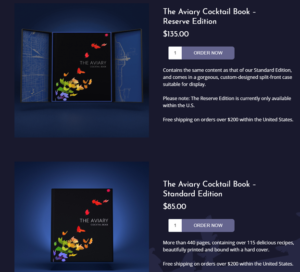
Knowing all the black box secrets allowed Nick to let Allen and Sarah take a year-and-a-half to go balls to the wall on creating a stellar product that someone, upon sitting in front of this book, would understand that the price of $135 or $85 dollars was money well spent.
They raised a half-million dollars on Kickstarter for this book. The primary reason Nick set up the project on that platform was NOT to raise money… but instead it was to raise awareness for it.
It was this idea of using the popularity and shareable disarming elements of Kick Starter as an under the radar, low-key method to advertise the book.
As of the day this podcast interview was released, the book hadn’t even been released yet… and they’d already sold an additional $300,000 worth of these books.
They’ve invested almost million dollars into the creation of this book.
They have two prices but those numbers tell you that no fewer than 9,000 SELF-PUBLISHED books (no publisher, no distributor) sold for $85 dollars apiece – $800,000 dollars-worth – which means they made almost ALL of their money back BEFORE anyone had even seen, felt, or smelt the actual book.
And it’s not written in a specific way that caters to ONLY beginners or… ONLY professionals. Professionals can learn a ton from it… and beginners can do 50% of what is in there at home.
He expects to sell 500,000 of them over the span of the next 2-3 years.
Every single publisher he had spoken with told him that “You can’t sell a cocktail book for more than $30 dollars” “There’s no market for it” and… “you don’t need to waste money on pictures because its just liquid in a glass.”
Just as he’s done over and over again, he proved that the black box industry way is NOT the ONLY way.
Just as he did with The Alinea Project, Allen documented the making of this book and you can see the journey they went on here which I highly recommend doing.
Another One of The Biggest Creativity Problems In The Restaurant Industry… Solved
No matter what the restaurant is, it pretty much only stays hot for the first 6 months.
The first six months is when you get all your lay down sales – people who need almost zero convincing for why they should buy.
What comes after the novelty wears off is the struggle to do what every business owner should be doing – consistently looking for ways to fill the pipeline with new prospects and working towards cultivating a list of regulars who frequent often, refer, and spend higher and higher amounts.
The other big impediment comes from the chef themselves getting bored with a style of cuisine after six months.
Next, was Nick and Chef Grant Achatz’s answer to this.
What surprised Nick was how versatile the chefs in his restaurants were with different cuisines.
With this in mind, Nick thought, “Let’s have a restaurant where the cuisine changes entirely every four months.”
It took them a year of kicking this idea around for them to get the ball rolling and actually turn this premise into a reality.
But rather than just doing “French” they torqued it down to “Paris 1906.”
THAT is far more intriguing than a generalized term like French cuisine.
This kind of specificity allows for differentiation in a niche that is flooded with generalists.
This gave them the ticket to time travel not just French cuisine… but the world’s cuisine.
This was an alluring cure for boredom on behalf of both Chefs AND consumers.
And yet again Nick and Grant’s compounded wisdom ensured that they executed in a way that this overly crowded market appreciated…
Next has received an unprecedented nineteen 4-star reviews from the Chicago Tribune and won a James Beard Award as Best New Restaurant in America.
All of their hard won wisdom and willingness to embrace Process change allowed them to defy the odds yet again.
Conclusion:
When people ask Nick Kokonas what he does, he tells them that he’s a writer.
To reach this point, you just read or skimmed almost 11,000 words.
Does anything you just learned about Nick’s legendary entrepreneurial journey lead you to believe that “writer” would be the first thing that comes to his mind?
Well, I guess you could point to him co-authoring Grant’s autobiography and writing for the Aviary book.
You can’t take those credits away from him.
But the term “writer” is an identity most often connected to a person who makes their entire living from the words they sell via articles, books, sales letters, advertisements, speeches, scripts, etc.
Nothing that we’ve covered up until now tells you that this is his experience.
So, for what reason would he give this answer?
Here’s why…
He attributes this title to himself because he writes 400 emails a day for his business.
This skill is of critical importance to him.
In fact, this is one of his litmus tests for knowing whether or not someone will be a good hire for him – if they like to write or not.
He has zero time for people who can’t put together effective/efficient communication via email.
When I think back to how well his majoring in philosophy has served him in his life, this response starts to make total sense.
It’s the way he expresses what he’s thinking in order to get shit done… and it also serves as an insight into how the person he’s communicating thinks when they’re stripped of any aids/impediments (physical appearance, clothes, expressions, gestures, tonality, distractions based on the environment, etc.)
Everything funnels back to his super power… the questioning of how well am I thinking about this situation? And how well is this other person or these other people thinking about this situation?
Judging by his track record, it would seem that these are some variation of two of Nick’s primary questions that are continually being asked of him by his subconscious mind.
If they are, this would perfectly explain his continued mastery of Process Change… his ability to succeed in business by breaking all the rules.
Upon being exposed to his approach to business, it was far too impressive for me to just simply be in awe of it for the duration of Tim’s podcast.
It is my sincere hope that something you’ve seen here will remind you to embrace and embody this spirit of a common sense philosophy when it comes to industry norms that threaten your potential and limit your prosperity.
Talk soon,
Lewis LaLanne