Use what you learn here to create a masterpiece… or not
In Part 1 of this series we talked in detail about how revealing valuable, often overlooked insights about your personal narrative allows for the following elegant and insanely effective conversion process to unfold…
Step one: You take them from “They don’t know you” to “Now they know you.”
Step two: You take them from “They know you” to “Now they like you.”
Step three: You take them from “They like you” to “Now they trust you.”
Step four: You take them from “They trust you” to “Now they’re working with you.”
While writing this piece I came across these four steps in an autoresponder email I received from the marketing wizard Dean Jackson.
As I was reading them, it dawned on me that Dan Kennedy’s Influential Writing system shows you how to move people through each of these phases in your marketing and content.
So, in the first part of this series we focused on how the Legendary Bob Ross was using personal narrative to ease people through this influence sequence by dropping bite-sized real-life tidbits about himself and his personal philosophy into the 400+ episodes of “The Joy of Painting” mega-hit show.
Today we’re going to delve into how his teaching content itself fueled a gentle, yet brutally effective conversion process to unfold and build a $15 million-dollar business.
We’ll start off by uncovering…
How Bob Used Game Changer Principle #15:
Desires Met Via Being The Welcomed Prophet
To influence people, you need to give them what they want.
And as simple and “DUH!!!” as this sounds, you’d be surprised at how you can look around and see loads of people trying to sell what people don’t want.
Since no one has ever taught them the nuances of what the market REALLY wants, they sell what they think the market should want… and then when their stuff doesn’t sell… they blame the economy or something else for having failed.
If you want a winning recipe, you’ll use what you learn here to figure out what people want and how you can fulfill these desires within the content and products you can deliver and here is one the most valuable truths you could ever learn relevant to this task…
People want simple certainties.
They don’t want complex answers to complex problems.
They want SIMPLE answers to complex problems… delivered in a very certain and definitive manner.
Look at how this works plays out in the real world…
->>> Joel O’Steen, the mega church guy, presents the idea that prayer can increase your odds of getting blessed with what you want. And he does this without reading you a ton of boring stuff from the bible.
->>> Jim Cramer, the money guy, picks stocks for you. Gives you a yes/no, buy/sell answers to your question which directly appeals to everyone’s wish to have someone tell them what to do.
->>> Look at The Atkins Diet book. In a simple to breeze through guide you know what to eat, what not to eat in order to lose weight. Compare this with reading an article in the Harvard Medical Journal about weight loss.
->>> Think now about Universal Health Care. No one wants to hear about how it’s gonna be paid for or how effective of care will be delivered. They just want to be convinced they can have it by someone who can convince them.
People want to believe in mystics and mysticism. They are highly motivated to take things on faith.
Kennedy talks about how this tendency even plays out when the discussion of something like mailing lists is brought up.
People want to know what list to mail to and where to get it.
Their eyes start glazing over and they get restless as Kennedy tells them about the necessity to find list biases, the need to reverse engineer the list and merge purge in order to find the tiny segment of the list that’s going to be successful for you all within the list you buy.
This is a very complex answer to a simple question.
He has yet to figure out a simple answer to this question of, “What list should I buy?”
Next…
Think about how the book Psycho-Cybernetics has been in print non-stop since 1960, selling at least 100,000 copies every year with no advertising, no marketing, no kind of promotion at all, no blessing from Oprah, and a pretty a shitty title that confuses more people to NOT buy it than it convinces to buy it.
Why does this book kick ass despite only having word of mouth advertising working for it?
Because it offers you a simple certainty – Think more highly of yourself in a ritualized manner and you’ll automatically attract more money, more sex, more friends, etc.
This is a very simple answer to a very complex problem. And there’s evidence that the world has responded extremely well to this message.
The principle of desires met is about figuring out your perfect prospects specific emotional desires and then figuring out how to deliver the results to them that generate those feelings.
You don’t influence with information. You inform.
You don’t influence with education. You educate.
People don’t want more information or education. They want simple answers.
You don’t merely want better informed and smarter people. You want people who are bonded to you to the point they’re willing to march into battle for you. And can’t accomplish this with huge data dumps alone.
People want ideas/people to believe and have faith in that don’t require them to be overly analytical.
People don’t really want to be smarter.
What they want are the results that smarter people get… without having to do excessive hard work. They want their problems to be dissolved as easily as possible.
The question is, “How far will you go?” and “Will you deliver it?”
How Would Someone Like Bob Ross Deliver On This Critical Objective?
People who nail this principle stand on a philosophy they preach.
Bob’s stance was that anybody can paint. He believed that all you needed was that desire to take the first step.
That’s about as simple as you can get.
His avatar includes the people who believed that they don’t have any talent, that they can’t even draw a straight line.
He believed talent was a pursued interest and that if you were willing to practice, you could develop more talent than you have now.
Bob knew who he was talking to as a result of the years he’d spent in the trenches teaching classes to people who were scared shitless, shaking as they put the blade to the canvas because they had zero background in art, knowing nothing about brushes, paints, canvases.
His experience taught him that when you get someone sitting in front of a canvas for the very first time and with the right guidance, they end up with a painting that was a billion times better than they ever believed they’d be able to produce, this is a direct line to them convincing themselves that you are the truth.
This is the kind of revelation that inspired people to become Bob Ross instructors.
Bob fell in love with the looks on people’s faces when they were proud of their paintings.
Everything he did revolved around this premise of “Anybody can paint.”
He would showcase kids and adults on his show who used his techniques to win the contests he held.
He even proved that you could paint even if you were color blind.
Simple and Steady Wins The Race
Even after The Joy of Painting became a major success, they never changed the set.
It was Bob, black curtains, three cameras, his palette, his blade and brushes, and his easel.
For all the audience knew they could have been shooting this in his basement.
You have to consider the unconscious effect this “every day man” set up had on the audience. They can look at this and say, all I need is enough space to set up an easel and I’m in business.
You don’t inspire the idea that “anybody can paint” when you’re shooting in a fancy location, with fancy tools, fancy clothes, with a fancy-looking person, teaching with all kinds of fancy art talk.
Bob also knew that an elaborate set would prevent him from creating airtight intimacy with the viewer…
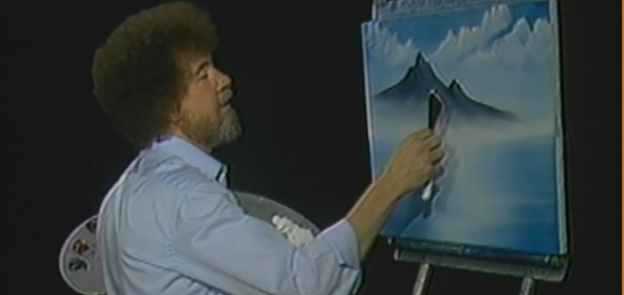
In this no-frills setting, he could speak as quietly to you as your doctor would when you were sitting on his table.
You can’t do this on an elevated stage where you’re going back and forth from speaking directly to three cameras and also having to project your voice and scan a room with your gaze from wall to wall while addressing 75 people in a studio audience.
He deliberately kept his line of paints as simple as possible, centered on eight colors so that novice painters could jump in and get started right away.
This ensured that his customers didn’t have to be experts in oil paints. He eliminated the possibility of his customers getting confused by the wide array of selections on the market offered by his competition.
Landscapes were the simplicity sweet spot.
He knew that there is no one way to draw a tree or a mountain.
This meant you didn’t have to worry about being perfect in this realm whereas if you’re painting people realistically, we all know how eyes, hands, ears, bodies etc. should look.
There is far less room for error when you have a narrowly defined objective with a ton of intricacies.
I believe there is a secret here though in that it wasn’t TOO EASY.
While what he was teaching wasn’t the High Renaissance quality of the ceiling of the Sistine Chapel… it was far from a child’s water paint-by-the-numbers book.
What he was selling hit that Goldilocks spot of “Good Enough” and THAT was why I believe he was able to sell the hell out of it.
Had he gone the way of being a snob about this whole thing, making it all about him, making it seem as if no one but the ultra-talented should paint, making it seem as if you should only be doing this if you’ve had a superior education and that anything less than art gallery-worthy paintings shouldn’t be allowed to exist… he would have turned off everyone except the professionals.
Sure, some people may have watched the show… but it would have been an entirely different challenge trying to make an information business out of the philosophy of “not everyone can paint.”
Instead of talking to people who were blank canvases… you’d be talking to people who think they know it all.
That’s two whole different pitches. You’ve gone from herding sheep who just do what you tell them to do… to herding cats who are set in their ways and do what they want to do.
Bob Ross Achieved Welcomed Prophet Status
Cult recruiters don’t look for challenges to conquer – they look for people ready, willing, and able to be converted.
If you want maximum profitability in your business, you’ll do everything you can to to avoid taking on the task of changing the minds of ignorant, resistant, and adversarial people to your way of thinking.
If in the instance of every day trivial conversations such as those people have about whether New York or Chicago has the better pizza, it is a lost cause to try to convince someone in love with one option that the other is better, think about how insanely stupid it is to do this with prospects who know that you’re trying to get money from them.
You need to realize that the big money is to be made when you’re saying things that reinforce and validate what people already believe. People grant loyalty and money to those who reinforce all the reasons why they’re right.
You’ve got to put some thought into this because to have total integrity, you’re gonna have to deliver some info to people that they’re not gonna be immediately receptive to and you’ve gotta be careful about how you do it because communicating for profit is more about reinforcement and validation than it is persuasion/conversion.
This tells us that we want to show up as “X” to an audience that wants “X” and that showing up as “Y” will get us crucified.
When Ted Broer was speaking on the Success tour with Dan Kennedy with his, “10 Foods Never To Eat” pitch, the only place he bombed was Alabama.
He was crying to Dan about how terrible his sales numbers were after the first time they’d visited Birmingham. He couldn’t figure out what went wrong.
Dan pointed out that in his speech Ted tells this crowd that they can’t drink soda, can’t eat cheeseburgers, and can’t eat moon pies and how his system eliminates the staples of their whole damn diet.
The stadium they were speaking at was in the shadow of the Coca Cola plant. This is the diet of this town. These people are sitting on mesh folding lawn chairs on their porch eating cheeseburgers, moon pies, drinking a Dr. Pepper. What did he expect would happen?
Selling unwelcome advice is ugly work and usually the only time it pays to sell it is after you’ve had someone ascend in a relationship with you relative to your product ladder or… when someone has gotten into a private client working arrangement with you.
People will shop for advice until they find somebody giving them advice they like and only then will they proceed to shower this person with their dollars.
Your place needs to be a friendly place for your perfect prospects.
If your customers are not children who are forced to sit in a room with you, it is a fool’s errand to take on the role of nun-like enforcer whose mission is to ram beliefs and lessons down the throats of unwilling customers and cracking rulers over their hands when they resist or disobey.
If your prospects aren’t trapped, they will simply leave if your information world starts to feel like a classroom.
Dan never wanted to be in the conversion business.
What does this mean?
It means that he never wanted any kind of speaking engagement where he was going to be put in front of people that didn’t understand direct marketing and more importantly, didn’t want to hear about it.
He knew this kind of group would be close minded to what he was selling.
The same thing goes for individual clients.
Dan has had four instances where he’s had to spend a full day trying to get people to get direct marketing, that don’t get it. This is ugly work.
Now he’s modified this process to where he’s put together a “Direct Marketing For Dummies” kit that he sends and demands everyone on the board have listened to the audio and read the book or else he isn’t gonna show up.
He’d rather put himself in front of a smaller group of people who do get it and save himself a ton of stress.
Who Should Be Your Customer/Client and Who Shouldn’t?
How should you be presenting yourself?
What should your message consist of?
What products and services should you develop based on who benefit most by you helping them?
The source of where your prospects come from is of MEGA-IMPORTANCE.
Picking the low hanging fruit is a great short-term strategy.
The great long-term strategy is to be filling rooms with people who have plenty of money.
Think about who Bob Ross’s perfect prospect is…
People who have enough spare money, time, desire, and space to paint.
Here’s what’s crazy… Bob’s company estimates that only around 3% of the people watching the show actually paint with him or on their own at a later time.
Millions of people watching… and 3% of them actually paint.
And who knows what percentage of these people bought painting supplies, books, or classes from him.
It’s hard to imagine it was all 3% but whatever the number was, it was enough for this to end up being a $15 million-dollar business.
Here’s the thing…
EVERYONE who watches, does so because they enjoy his company and love seeing what he’s accomplishing during each episode.
The 97% of people who never paint unwind while letting Bob’s warmth and gentleness enchant them with the good feelings he puts into their hearts.
People who never bought a single thing from him helped him tremendously by boosting the viewership numbers which is what kept his “edu-tainment” on the air up until the last year before he died… and for decades after.
For this massive audience, Bob is a Welcomed Prophet whose approach met their desires.
Here is One Major Thing That Welcomed Prophets Understand…
A book that shines light on this “Welcomed Prophet” principle, that Dan recommends everyone get is “What a Way To Make a Living” by Lyman Wood.
The author of this book had a great mail order business that revolved around selling “lucky” rabbits’ feet. Along with the feet, they would send along these little pre-done prayers.
Well, soon enough these guys got to be so successful that the FTC told them they couldn’t be making the claims about rabbits’ feet that they were.
But the FTC can’t touch religion.
You can make any claims you want about prayers so Lyman’s solution to being put out of the “lucky” rabbits’ feet business was to just sell the prayers they’d been previously giving away for free.
In this book, Lyman says, “We already know our market. Millions and millions of people who want to pray but aren’t articulate. They don’t know what to say. We’ll publish a magazine that has prayers and tell them what to say.”
Huge lesson to be had here: People hate the idea of figuring shit out on their own and would prefer to be told exactly what to do in order to get the results they want. Over. Period. Done.
One of the best examples of this that Kennedy saw on the market was the book, “Eat This, Not That.”
This book has a list of 50 of the major restaurant chains in America and it tells you what to eat at these places so that you can lose weight.
THIS is welcomed prophet status at its finest.
This is brilliant. This is what you need to be doing if you want a long list of raving fans singing your praise.
Bob Ross was the Welcome Prophet to his prospects at the expense of losing the respect of his peers…
Traditional Artists Laughed at Bob Ross…
Bob Ross Shrugged It Off As He Laughed All The Way To The Bank
You know you’ve hit a sweet spot in the market when the customer is amazed by the results they get from a course of action that requires little to no thought on their part.
Snobby artists and teachers – the famous ones, the nobodies, and everyone in between – laughed at how “overly simplistic” Bob’s method was.
To these uppity assholes, being a “star” on Free Public Television was the equivalent of being the least smelly and dirty lunch room kid at school.
The elitists rationalized their bullying by looking for all the imperfections in his teachings. For example, they would point out how some of his color combinations weren’t found in the natural world.
And of course, this shit talking would bleed over to his customers… “I can’t believe these losers following his how-to baby steps actually try to call them artists.”
Bob didn’t let any of this knock him out of his Welcomed Prophet lane.
He wanted people to see they could create very good paintings from very little instruction, a lot of happiness, and a newfound confidence in their ability to create without having attended art classes or an art school for twenty years.
Traditional artists wrote Bob off as a talentless hack the same way that psychologists and therapists do with Tony Robbins.
Neither Bob nor Tony graduated from prestigious universities with advanced degrees in what they teach.
Shit, neither of them attended any college at all.
If this happened to Tony in a profession where psychologists and therapists are raking in the money hand over fist… it should come as no surprise at all that it would happen to a dude who had a $15 million-dollar business in a niche where hardly anyone makes any money at all.
The reality is, Bob does everything “legitimate” artists do. What separates him from the people who take themselves way too seriously is he doesn’t explain what he’s doing in a complicated, jargon-loaded, self-important way.
You’ll never hear him use the term, “perspective.” Instead he’ll tell you to make the color light in the distance. If a $1-dollar term will get the job done he’ll take it over the $100-dollar term every time.
He’s not teaching you the rules like an art professor would.
He’s not telling you what NOT to do in terms of knowing how to balance the foreground and the background, how to not put things in the middle, etc. He just does what you’re supposed to do and invites you to follow his example.
Not bogging down the process of learning by making it more complicated than it needs to be is one of the commonalities of the teachers who have higher than average success rates.
This criticism of a stream-lined approach reminds me of all the bullshit Michel Thomas endured when he was teaching people to fluently speak a new language in five days while college professors struggled to accomplish this feat in years with students who had already taken language classes in high school.
Michel didn’t give a shit what language professors thought about him – especially since none of them would respond to the challenge he threw down to them.
Tony doesn’t give a shit what “real therapists and psychologists” think of him
Bob didn’t give a shit what “real artists” thought of him.
And this was easy to do because his goal was NEVER to be thought of as a great artist or even to teach others to be.
He told the world that he knows his work will never hang in a museum. He said, “It’s not traditional art. It’s not fine art. And I don’t tell anybody that it is.”
He was realistic and was dedicated to teaching a form of art that anybody can do… art for anyone who wanted to put a dream on canvas.
His goal was simple… to get people to experience the joy of painting.
What made this possible was him removing his audience’s fear of failure.
He knew the keys to getting started were believing in yourself and having the confidence to carry on.
It could be said that he has got more people into art than anyone else in the history of art because of his simplified teaching approach.
Is your approach to teaching the market making it easier or harder for your perfect prospects to support your business?
How Bob Ross Used Game Changer Principle #21:
Proof
When it comes to proving your product or service does what you say it will and that you’re the king, testimonials are one of the ways everyone knows to use.
But here are some other things that can serve to demonstrate that you are indeed influential…
->>> Name-Dropping/Who You Associate With:
When you’re surrounded by rock stars, you’re perceived to be one also.
Peter Lowe accomplished this with his Success rallies. He didn’t do this by being charismatic. He did it by writing checks. This allowed him to surround himself with a mix of prominent people.
As the result of working this tour with Peter, Dan Kennedy has been able to drop the names of former Presidents of the United States, astronauts, movie stars, etc. and say he’s shared the platform with these guys.
This has allowed him to make a strong impression on his audience.
He says the name-dropping has been FAR more valuable than the money he got paid from making sales at the event.
You can do this too by pulling out the check book and it’s gonna make an impact.
You could do this with seminars, tele-seminars, coaching programs, forwards in your books, articles in your newsletters, content on your websites.
You’re aiming to surround yourself with both people with great prominence/credibility or… great celebrity power or… preferably both.
And be sure to use pictures, quotes, sound bites, video, etc. from any of this you have in 49 different places all over in all the processes of your business.
As we discussed in the Part 1 of this series, Bob was publicly anointed the new king by the previous ruler of the Public Television art shows, Bill Alexander.
Another time Bob got invited to the Grand Ol Opry as a celebrity guest and was interviewed by one of his favorite country singers, Hank Snow.
Bob got the experience of a bunch of famous country singers come up and tell him that they loved his show.
He then went on to give Hank Snow a private class where Hank told Bob he learned more in two days than he could learn in a year without Bob’s help.
->>> Where You’ve Been Seen In The Media:
In 1989 the major day time talk shows came a calling on Bob Ross.
By this time, Bob was so in tune with who his perfect prospects were that when the Oprah show called and didn’t want him to paint… but instead wanted him to be on an episode of the show that featured married couples who are in business together… but don’t live together… he turned her down.
If he couldn’t do his shtick that he knew would fill more of his classes up, sell his books, or sell his painting supplies, he didn’t see the point in being there.
So, he declined Oprah’s invitation.
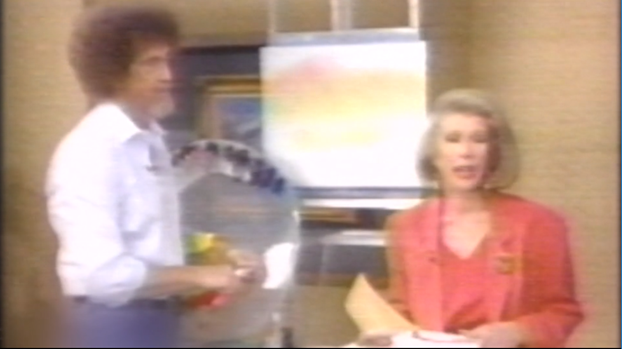
Talk shows like Joan Rivers’, “Live with Regis and Kathie Lee”, and Phil Donahue let him do so and this allowed him to put his best foot forward thus letting his charm be broadcast into millions of living rooms that Public Television was never watched in.
The famed talk show host Phil Donahue, when recalling bringing Bob Ross onto his show, talks about how mesmerized his audience was by him.
During this appearance Phil showed the audience a painting that I’m assuming Bob coached him through and the audience totally loved this.
Long after Bob’s death Phil said, “When your 29 years on the air with a live audience every day, you get pretty good at reading audiences. And this audience at the time that he did our show was totally wrapped.”
He became a Pop Culture icon.
He had a spot promo he did for MTV – Music Television…
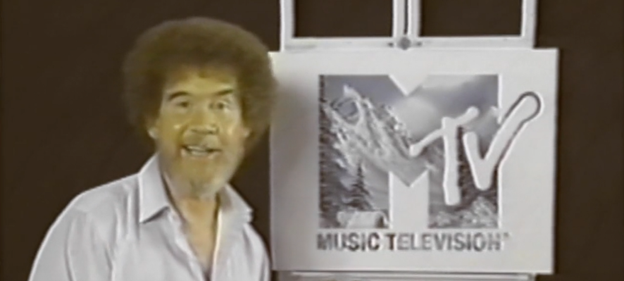
He had a spoof he did on HBO, he was featured in a hair dye add for women, and after selling his products on QVC one time he got off stage and was told that the legendary actor Marlon Brando, the famous actor who was part of TIME magazine’s “Time 100: The Most Important People of the Century” had called in and wanted to tell Bob what a big fan of his that he was.
->>> Who Is Taking You Seriously:
If someone influential, that your audience knows of is taking you seriously, you want to make a big deal out of that.
You’ve got to be aware of something like this aging too.
When Dan Kennedy wrote copy for Paul Hartunian, he changed the copy from, having “appeared on the Johnny Carson Show,” to “appeared on the “Tonight Show”. He didn’t lie. It was the “Tonight Show” when Carson was on it but that Carson reference is so old it has mold on it and there’s a ton of people who don’t even know who Carson is.
But if they hear “Tonight Show” it’s Leno/Fallon and its current in their mind.
->>> Daring Adventures & Experiences:
If you do any kind of Richard Branson-type activities (hot-air ballooning long distances, marathon running, hang-gliding, going on safaris, etc.) that most people would have a, “REALLY! YOU DO THAT?” kind of reaction to, then use them in your conversations.
They may seem frivolous, but they’ll definitely make you a more interesting person in the eyes of people who want to give you money.
For Bob, a lot of people who didn’t any exposure to pets other than dogs or cats would have definitely thought of Bob as being adventurous when he told the tales of having a wild assortment of wild animals as his pets as a child… and also rehabilitating injured wild animals.
->>> Stunts You’ve Pulled That Have Shined The Light On You:
Bob Allen, the “get rich in real estate guy”, once picked someone off the unemployment line and had a reporter following them around and in the span of three days, the homeless guy had bought a property with no money down.
This is a stunt.
It gave him something to talk/brag about for at least a couple years after that.
There’s a Bob Allen Challenge in most businesses. You’ve just gotta figure it out for your bidniz.
One thing you should know about any form of stunt is that professionals know in advance what the outcome is going to be. Only an idiot would totally wing a “daring act” and put their neck on the line without knowing what the end result is going to be.
Bob Ross was doing “Fake Live” before most of these internet kids doing so on webinars and “live” streams were even wiping their own ass.
If you didn’t know better you would think that Bob is coming up with these paintings off the top of his head but they were not as spontaneous as it seemed.
In fact, Ross made three of the same paintings for every episode.
The first was sitting off camera and was used for reference which no one beyond the crew ever saw because sometimes in the span of twenty-six minutes and forty-four seconds that the show ran Bob wouldn’t have time to insert some of the finer details that he’d put into the reference painting he’d done when he wasn’t rushed.
The second painting was what the viewers saw him creating on TV.
And the third was a more detailed landscape he painted used for the illustrations included in his instructional books.
Ross was meticulous.
“Bob used to lay in bed at night, he told me, he rehearsed every word and brush stroke,” Annette Kowalski says. “He knew exactly what he was going to do and say on every one of those programs.”
Think about how I’m at the end of this list and nowhere have I mentioned “Showcasing Your Expensive Items/Opportunities That Only The Successful Can Afford.”
Bob drove a Corvette and almost none of his fans/customers ever knew about this until after he died.
Why?
Because bragging about your vette doesn’t work for this pitch (primarily selling painting supplies and art classes) to this audience (wannabe artists who are watching free TV when paid cable/satellite is considered the gold standard).
He would get far more bang for his buck with a Public Television audience talking about how expensive it is for him to rehabilitate wild animals than he would bragging about how cool his car is.
This is something where you’re giving the impression that you’re doing well… which is important for would-be perfect prospects for your certification classes… that doesn’t feel like you’re disconnecting from your humble persona.
When it comes to proof, you have to know what proof will be most appreciated by your perfect prospects.
How Bob Ross Used Game Changer Principle #26:
Persuasion
There are really only 3 kinds of categories of books we’d use in our marketing efforts . . .
First… would be some variation on the text book.
Bob Stone’s “Direct Marketing” book is a classic example of this. It’s not trying to convince you of anything. Not trying to motivate. Not attempting to get you to advocate a philosophy. It doesn’t care to persuade you to one idea or another. It just lays down the math and procedures and processes of a direct marketing business. Very dryly. Just like a school text book.
Second… would be reference books.
These have formulas/forms in them that are intended to be used over and over again with no other real purpose.
Third… and most useful to you, Story and Advocacy books.
What is interesting is if you look at books like Think and Grow Rich, that fall into this category, and refuse to die, you’ll notice they’re built more like sales letters than they are like the books above.
They’re more akin to story books than they are teaching books.
Think about how the only real content in Think and Grow Rich is the description of the 17 principles that no one can remember.
Outside of this, you’re not getting any real help actually implementing these 17 principles.
All you’re getting is a sales letter for the philosophy they want you to accept.
You’ve got a list of what to do that could fit on one page. There’s one little how-to guide for writing goals. But the rest of the book is designed to sell you on the wisdom of the 17 principles.
If you took all the chapter breaks and pushed all the content into one web page, one long continuous letter, it wouldn’t be too much different from a sales letter. Same thing is true of Psycho-Cybernetics.
Actually, one of the things publishers have done through years to these books is put summaries at the end of the chapters to make them seem more content-rich.
There Is a Basic Template For Writing One of These Advocacy Story Books…
One of the guys at Dan’s workshop was a high-end cosmetic dental surgeon.
Dan talked about how normal book editors might tell him it’s a good idea to write a book about the “212 Steps For Profitable Case Presentations” – i.e. the process of making the case to the cosmetic dentist’s prospect that convinces them to take advantage of the dentist’s services.
Dan thinks this cosmetic dentist would be an idiot if he wrote this book.
Here’s why…
Any time you write a book the question you have to ask is… “What is the purpose of this book?”
Now, in case you don’t know, a cosmetic dentist stands to make $40-$50,000 dollars on just one sale.
So… if your purpose for writing this book is to sow the soil in order to get your most successful peers clamoring and fighting with each other for the opportunity to hand you serious money in order to be personally coached by you on the process for securing more high-end cases… then you realize it would be dumb to do a cheap book on this topic because this same information could be sold in other formats for way more money.
This “212 Steps For Profitable Case Presentations” concept/opportunity lends itself to being a weekend seminar that sells for $10-$15,000 dollars per person.
You could host this event, tape it, and the next step would be to sell this information on DVD’s/CD’s/Digital for half the price of what people paid to attend the live event.
Only after you’d done this, would you even contemplate doing a book on the topic.
Here’s what a book that draws prospects to this kind of business would look like…
The content for an advocacy story book revolves around the premise of convincing dentists that a huge promise like this is possible for them to achieve…
“The Secret To Securing At Least Two $50,000 Dollar Cases Every Month Like Clockwork”
Most dentists don’t believe this is possible.
If they can see with their own eyes that you’re doing it, they have Eeyore the Donkey Syndrome, “Sure it’s possible for you, but I don’t think I can do it.”
This book should be answering ALL of the perfect prospect’s objections for why they can’t do this… showing them how it is possible to do it and… telling them why it’s a better to have a practice that offers high-end cases.
A lot of the book wouldn’t be about case presentation at all, even though the title suggests that it would.
What you primarily want to fill the pages of this book with are success stories that address all their fears of offering premium priced services.
In this book would be a lot of how to do it, but not a lot of what to do. You don’t want to get ahead of the person by telling them what to do… without first preparing the reader and broadening their horizons as to how it is possible to do.
If you want an example of what this kind of content looks like, look no further than the book “Think and Grow Rich.”
It would consist of checklists of these 7 things to do, these 9 things never to do, these 14 steps of the process… but all you’ve got are lists.
In a book like this, unless you want it to be 1,000 pages, you’re not gonna have enough room to give them the full seminar experience so you give them brain dead easy tools so they feel like they’re coming away with content which they are but it is all incomplete content that needs deeper introspection.
“If These How-To Books Reign Supreme, Doesn’t The Ultimate Sales Letter Work Against You?”
One of the participants pointed out the fact that Dan Kennedy’s “The Ultimate Sales Letter” was a reference book and asked him if it actually hurt his copywriting business.
Dan talked about how this book does NOT get in the way of people hiring him because it only gives people the checklist and examples of what good and bad copy looks like.
If you’re starting at zero, you can actually read that book and improve your ability to write.
For the actual small business owner who has limited competition who doesn’t know anything about direct response advertising, this book will actually give them a gigantic advantage.
Here’s what most people don’t understand… 95% of entrepreneurs are not an ideal prospect for Dan Kennedy.
But for the type of person that Dan’s looking to bring on as a client, this book is the first step in many that when fully acted upon and appreciated, will bring a person one-step closer to being a perfect prospect for him.
The tools in the book are FAR too basic for what an advanced marketer needs to accomplish but it shows them that Dan knows what the hell he’s talking about and it shows them he thinks outside of the box in a results-based fashion.
Dan’s “Ultimate Sales Letter” book is similar to Vic Schwab’s “How To Write A Good Advertisement” book. There’s not a whole lot you can do with that book, but Kennedy likes it for the fact of being able to swipe from the 100 best headlines list in it.
The good thing about reference books is they stay on book store bookshelves for a long time without having to create any kind of emotional bond.
“The Ultimate Sales Letter” and “The Ultimate Marketing Plan” have brought Dan lots of speaking engagements… companies calling him up asking him to come teach their team this stuff… but have generated hardly any customers.
The NO B.S. books however, have brought him a TON of customers but hardly any speaking engagements.
There’s an author who put out a book called “1,001 Ways to Market Your Books”.
This guys’ consulting practice had always stayed cheap and it’d always stayed small because that was the only reason people are coming to him.
There was no emotional “I want to have a beer with this guy and get to know him better,” connection.
Dan has tried to fix this in the new editions of his reference books. He’s made the books fatter, but the fat isn’t more teaching. The fat is more stories and inclusion of personal narrative stuff.
Here is something that I believed served as inspiration for him to do this…
Out of the 25+ books that Dan has written, the book Dan gets the most fan correspondence about is his “Unfinished Business” book where every lesson/chapter is tied to stories about his personal life, going all the way back to him being a child.
If you get this book (which I highly recommend you do), you’ll easily find a ton of these Influential Writing principles on display in it.
He has learned over the years that the key with this style of book is…
NOT what you want them to “book learn” – but rather what kind of philosophy you want them to embrace.
NOT what do you want them to become capable of doing as the result of buying it – but rather what you want them to be inspired to do next.
People don’t prioritize being “taught” which means that teaching usually doesn’t serve all of our purposes as marketers.
The way you write these edu-tainment style of books is more similar to the way you’d write a sales letter than the way you’d a school text book.
Each chapter needs to be developed from its intended outcome backwards towards what you need the reader to believe.
Speaking and writing are really the business that info-marketers are in.
You need to define yourself in these terms.
The bottom line is, as a writer, you gotta write… or as a speaker, you gotta speak.
Consistency is what gets you subconsciously proficient at communicating in a captivating manner.
You’ve gotta decide that the business you’re in is really the business of influencing people by words in print or pixel, online or offline, and commit to getting really good at it.
Bob Ross didn’t need anyone to tell him any of this.
The “Joy of Painting” television show made him an irresistible celebrity that people wanted to learn from in person. And this is why even though they could shoot a series in a week for each quarter, there was no down time.
He knew the deal and that he needed to strike while the market was in heat.
Upon starting the first season of The Joy of Painting, Bob wanted to create a “How-To” book that served as a companion to the television program.
Bob didn’t have any serious juice at this time so the studio told him that if he wanted a book, he would have to publish it himself because it would cost around $30,000 dollars to do so.
Bob’s conviction that this was an essential step to growing the business inspired his business partners the Kowalskis to mortgage their home in order to fund it.
To produce the content, he would have his business partner stand behind him and take 50 or so photographs for each painting – one for each step in the process – for the how-to illustrations that would go into the book.
They would eventually go on to produce a book for every season of the show.
Let’s take a step back here…
Think about the show, “The Joy of Painting” itself.
If you were a viewer and had all the paints, the canvas, the palette, and you got everything prepared beforehand… you would be able to tune into the show live and move right along with each of Bob’s steps and create roughly the same image he did.
Back then in 1989, you could also record the show on your VCR and follow along later at your own pace if you didn’t want to rush through the painting in 26 minutes.
Today, you can simply stream the episodes at your convenience and pause the episode on your iPad or your Smart TV in order to move at your own pace.
This means you didn’t/don’t have to spend one dime with Bob in order to literally experience “The Joy of Painting.”
He’s giving away the instructions for how to do the same paintings that are featured in the how-to books and everyone can see this.
And yet, people still bought books and classes.
Why?
Speed and convenience. That’s why.
Recording a show on your VCR requires effort. Most people probably don’t have a TV/VCR in the same area where they paint. Most people probably don’t want to risk making a mess of their remote while trying to pause and follow along or splashing paint/thinner on the TV/iPad when cleaning their brushes.
If this is the case, buying the book makes sense.
And then of course, everyone knows that having hands-on instruction and personalized attention is going to be the fastest and surest path to success with any kind of skill.
This purchasing progression is logical… you buy lessons if you can afford them. You buy the book if you can’t. You buy his supplies for either route you take.
Even though enhanced pay-only options are available Bob still gets full credit for being generous with his content.
He gets DOUBLE BENEFIT – all the good will that comes from giving away the instructions on the show… and all the satisfaction that customers experience when they buy something from him and see all the care that he has put into making sure you get an amazing experience.
Let’s Now Further Consider Bob’s How-To Books…
You have to understand that these how-to books were a bridge between someone watching the show and merely being wowed by him… and someone actually hiring him for lessons or attending one of his workshops.
The law of averages would tell you that a tiny percentage of people who bought the book actually used the instructions in the book to do paintings.
That’s a universal truth that carries over to any kind of “non-urgent” how-to information that has ever been sold in the history of mankind.
The majority of the buyers bought the book with the intent of using it “someday” and simply thumbing through the pages served the purpose of showing these people that Bob was indeed a great teacher.
These books were physical evidence that demonstrated Bob had a system for teaching.
With this evidence in hand it was now 100 times easier for these buyers to decide that if the opportunity ever arose and they had spare money and time on hand… they would definitely be willing pay money to learn from him or one of his proteges directly.
Without doing any kind of hard sell at all, he had these book buyers primed to ascend to the next higher level in his funnel. This is what you call indirect selling.
People who didn’t buy these books had nowhere near this level of motivation to spend bigger amounts.
If you create a self-published how-to reference book, you have to bet that it is NOT going to make money. If it somehow takes off and becomes a mega-hit, cool. But you should be dancing in the streets with glee at having broken even on the sale of a book like this.
REMEMBER: Self-Published how-to books are to be thought of loss leaders, the same as any high-value freebies that you give away in any of your other lead generation efforts.
But unlike leads that come from freebies, the buyers of these cheap books are much more valuable leads than those who only opted in to get a freebie from you because they’ve actually bought something.
Smart marketers self-liquidate the process of giving books like this away for FREE by charging “only shipping and handling” for them.
When the Alexander company recommended that Bob sell his own line of paints because they couldn’t keep up with the demand, he took this opportunity to put his own touch on what he was doing.
He reduced the size of the largest brush and he also adjusted the formula of the paint itself because he knew what would work for a beginner. The consistency of the paint was very specific to his technique.
His products, with his smiling face on them, hitting the shelves of the commercial shelves now established his brand in the commercial art store world.
He was making his presence felt in both book stores AND commercial art supply stores and his entrepreneurial efforts increased the demand for more episodes of the series and teaching classes, which led to him growing his business by certifying people to teach others with his endorsement…
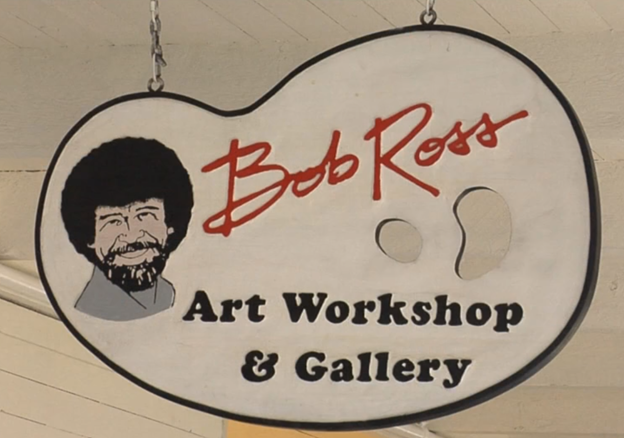
He wanted people all over the country to be able to learn this method in a classroom setting if they wanted to and this was his way of adapting to the reality of not being able to personally teach everyone who wanted to learn from him.
This meant training instructors would keep the wet-on-wet method and the message of “The Joy of Painting” alive and well long after Bob was gone.
The completely FREE 400 Episodes of “The Joy of Painting” were some of the finest content marketing that has ever been used to INDIRECTLY sell art books, supplies, classes, and certifications.
I say “indirectly” here because there was never any kind of pitch in the episodes of the show for anything Bob sold.
The most you heard about this stuff he sold was a brief mention that it existed.
And this laid-back approach allowed him to quietly build an insanely profitable business for himself.
If you agree with the premise that FREE consistent and compelling content can work miracles you want to keep a clear idea in mind of what this content should entail.
You want the content to be seen as valuable even though it is incomplete.
You want the content to be crafted in a way that eases people towards making more and more purchases from you.
Conclusion:
Your perfect prospects need to believe you’re a real human being that they want to have a beer with.
That’s the most important thing you need to remember.
People buy stuff from people they like.
They can not like you and still buy and there’s a set of skills you can learn to do that kind of selling. You can smooth talk people into buying. You can intimidate people into buying.
But none of those strategies make people won’t to keep coming back and giving you money over and over and over again.
Think of Joel Bauer here.
You can sell a ton of stuff being Joel Bauer. But that style isn’t going to keep people coming back year after year after year because you knocked these people into a stupor, took their wallet, propped them back up in their chair, and left them in a dazed and confused state to where they don’t know what the hell happened to them.
That slick approach invites buyer’s remorse.
The opposite of this is having people genuinely liking you and being fascinated with you.
All of these principles are what Dan uses to keep people in coaching for 5, 7, 10 years and beyond when they’ve got everything he knows after a year of being in coaching.
After a year of coaching you know Dan Kennedy direct marketing cold, so why hang around?
Because you like him and you feel he’s continually bringing value to your life.
These same principles allowed Bob to flat out dominate a huge niche as an entrepreneur… and to do it in a way that felt congruent with who he was at his core.
And his way of doing this enabled him to become a living legend and an unforgettable icon in this realm.
Of course, if you have any questions about what we’ve covered in this series, feel free to ask away below in the comments.
Talk soon,
Lewis LaLanne
“I’ve learned that people will forget what said, people will forget what you did, but people will never forget how you made them feel.”
~Maya Angelou
PS. If you have any interest in inserting the principles we’ve talked about along with 25 others we didn’t cover, into your marketing, you will definitely want to check out the notes we took on Dan Kennedy’s Game Changer DNA Influence Course.